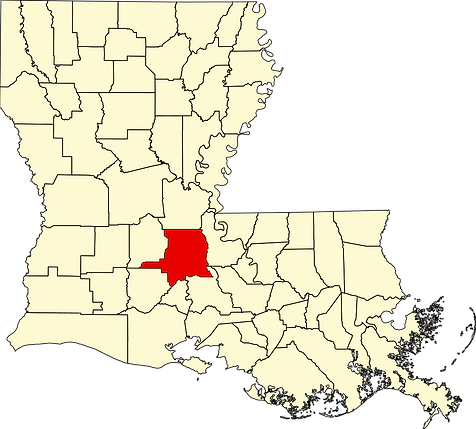
Saint Martin Parish

Population: 53,431
Median Household Income: $ 48,656
Persons in poverty: 18.7 %
High school graduate: 81.9 %
Bachelor’s degree or higher: 14.5 %
Persons without health insurance: 10.6 %
Households: 19,749
Number of Companies: 4,800
Men owned firms: 2,369
Women owned firms: 1,790
Veterans: 2,206
St. Martin Parish is a parish located in the U.S. state of Louisiana, founded in 1811. Its parish seat is St. Martinville, and the largest city is Breaux Bridge.
At the 2020 census, 51,767 people lived in the parish. St. Martin Parish is part of the Lafayette metropolitan area in the region of Acadiana, along the Gulf Coast.
St. Martin Parish (French: Paroisse de Saint-Martin) is a parish located in the U.S. state of Louisiana, founded in 1811. Its parish seat is St. Martinville, and the largest city is Breaux Bridge.[1] At the 2020 census, the population was 51,767.[2] St. Martin Parish is part of the Lafayette metropolitan area in the region of Acadiana, along the Gulf Coast.
History
In 1811, parts of Attakapas Parish were taken out to create St. Martin and St. Mary parishes. In 1824, the Louisiana State Legislature divided St. Martin Parish, resulting in the creation also of Lafayette Parish. In 1844, St. Martin Parish was again divided, yielding Vermilion Parish. In 1868, Iberia Parish was formed from parts of St. Martin Parish and St. Mary Parish. St. Martin Parish was divided into two, as part of Iberia Parish runs between the two non-contiguous parts of St. Martin Parish.
St. Martin Parish was largely colonized in the late 1700s by people from France and Acadia.[3] Their descendants have maintained the use of French and form a large concentration of French-speakers in the 21st century.
The Acadians brought the tale of Evangeline, a young woman said to have been separated from her mortally wounded betrothed during their expulsion by the British from their territory in eastern Canada. According to the tale, Evangeline later met her betrothed again in St. Martin Parish, but he had already committed to a new love. Evangeline never recovered from the shock of both finding and losing him again. Poet Henry Wadsworth Longfellow's work, Evangeline, A Tale of Acadie, was based on this story.
Evangeline was and remains an icon of Acadian and American culture. The historical Evangeline, who is believed by some to have been an orphan girl named Emmeline Labiche, was purportedly buried on the grounds of St. Martin de Tours Catholic Church in St. Martinville.[4]
St. Martin became a very prosperous parish, growing rapidly in the early 1800s. Most of the revenue at that time was being made by raising cattle. Planters also had profitable commodity crops such as cotton, sugar, corn, rice, and tobacco. These were sold to the New Orleans market. Wealthy planters depended on enslaved African Americans as labor on their plantations. By 1860, there were more than 7,000 enslaved African Americans in the parish. There were also numerous Anglo-American slaves brought to the parish.[3]
A yellow fever epidemic in 1855, followed by a deadly fire and a destructive hurricane, ended an era of unbridled prosperity for elite whites. Combined with the effects of the American Civil War and Reconstruction, the parish elite struggled in the postwar years. The transition to freedom for African Americans was uneven, as whites soon tried to reimpose supremacy and effectively denying them the franchise.
Geography
The parish of St. Martin is split into two non-contiguous parts because of a surveying error dating to 1868, when Iberia Parish was created by the Louisiana Legislature. Iberia Parish divides St. Martin Parish into two separate areas, Upper and Lower St. Martin. According to the U.S. Census Bureau, the parish has a total area of 816 square miles (2,110 km2), of which 738 square miles (1,910 km2) is land and 79 square miles (200 km2) (9.7%) is water.[5] St. Martin Parish is in the Atchafalaya Basin, with Bayou Teche running through it. The bayou was used to ship products to New Orleans.
St. Martin Parish has a wealth of oak and magnolia trees.
Protected areas
The parish has both national and state protected areas within its borders.
Cities & Zip Codes
Pierre Part, 70339
Morgan City, 70380
Arnaudville, 70512
Breaux Bridge, 70517
Broussard, 70518
New Iberia, 70560
Saint Martinville, 70582
Cade, 70519
Cecilia, 70521